The Fionavar Tapestry
Okay. Phew.
This is a good fantasy series, but I don’t recommend it to everyone. I DO recommend it to—
Anyone who ever read a Guy Gavriel Kay novel and said, “This is really good, but what if it were less political and more action-packed?” I’m glad to say the book for you exists, and Kay wrote it: The Fionavar Tapestry.
In our world’s Toronto, five ordinary college students encounter a mysterious wizard and dwarf. They are representatives, they say, from Fionavar, the first of all the Weaver’s worlds, the world which sets the pattern for all the others. And to five students— a loose study group— they offer the study abroad opportunity of a lifetime. A week in the Royal City, in the King’s hospitality. And not just any week, but a week of celebration, feasting, music under the flowering vines. Wow, what could possibly go wrong?
Do I sound cagey and aggravated? I am, somewhat. This book aggravated me. But to be fair, I have read some terrible works of fantasy. And this, The Fionavar Tapestry, is a good fantasy series.
Just kind of aggravating.
Maybe, say, it’s written by a young man who is very attached to his toys.
But to be honest about Mister Kay, this book has some great character work.
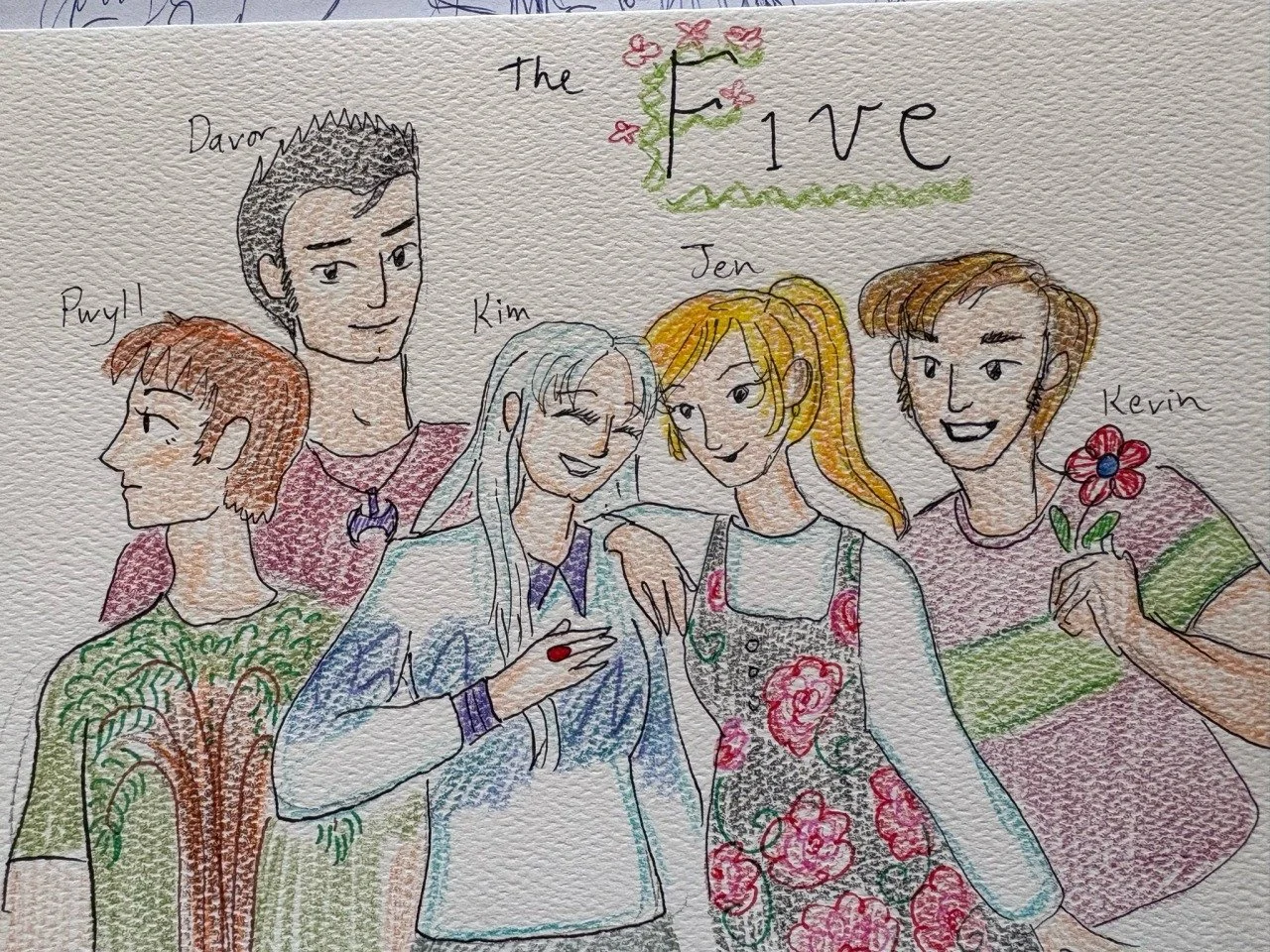
One of my favorite aspects of this book: the Five students themselves. Kimberly, Paul, Kevin, David, and Jennifer. I grew to love them so much. They are drawn well and rounded out. They care about each other— even if grief or other masks means they can’t exactly show it.
So, these Five travel to Fionavar— though the crossing is rough, and one of the is flung well out of the Royal City— but he’s safe. It doesn’t take long for the students to realize that something is deeply amiss. The land is scorched by drought, and the king weakens. How to aid the land in this hour of need? Well… each one finds a different answer to that question. As our Five travel, they find themselves pulled into different factions, supporting different causes. Each to her own path…
And to give Kay credit, the series generally has a good sense of momentum and pacing, even levity. I DO think it takes itself too seriously at times, considering the silliness of the premise (a wizard and a dwarf show up in modern day Toronto and whisk away five ordinary college students, and they fight an Evil Overlord).
And as usual with Kay, it takes about a hundred pages before the book snaps into gear with one killer sentence.
In book one, for me, that read:
“To hang on the Summer Tree and die.”
… Yes, that’s a powerfu line, and yet, I didn’t finish this series the first time I attempted it. Diarmud’s seduction of Sharra disgusted me. I think around then I got to Jennifer’s act I destiny and… I did not care for it.
However, on my second attempt, I pushed through to Davor’s time among the Riders of the Dalrei, and that hooked me.
It’s a bit unfair, as a writer, that Kay writes the big picture philosophy stuff so well, AND the little stuff. The way his characters care for one another invite the reader to care for them, as well. In short, he can really get you in the heartstrings. So Davor kind of carried this series for me. And I’m glad I finally read it; there are some really beautiful grace notes in this series.
The rest of the review goes under a spoiler. Proceed at your own risk.
[SPOILER]
I’ll tell you what, I think this book began as fanfiction of the Arthurian Legends. And the evidence I present to the jury… Arthur and Lancelot themselves. They remind me irresistibly of the fandom term, “Gary Stu,” which anyone can tell you is the marker of a very young writer. I’m saying that Arthur and Lancelot are perfect. In a world full of characters who doubt and err (and how I loved Kimberly for all her doubting), these guys gliiiide through life, serene and noble. And not only are they perfect, they’re each perfect in the same way. So in my mind’s eye I’ve got to cast Nathan Gunn (cleanshaven) as Lancelot and make Arthur tall and thin, about twenty years older, and he gets long drooping whiskers, so as to distinguish the two.
It’s as though Arthur and Lancelot were the author's darlings that he couldn't bear to change how perfect they are in his eyes—
—even as he developed other characters with more depth and nuance, such as Jennifer/Guinevere.
Which brings me to my next point…
The force of Guinevere, Lancelot, and Arthur has a powerful gravitational pull that actually detracts from the story.
It becomes the gravitational pull, rather, upon which the whole story hinges.
And… yes, I’m going to lecture the master, Kay, about this.
Guy Gavriel Kay needs to work on his yaoi.
The dude TELLS US but does not SHOW us that Arthur and Lancelot are in love with each other. I’m all for some Arthur x Lancelot tragic pining, but I didn’t get a sense of anything … you know, BETWEEN them. More like they stand side-by-side and sigh over Guinevere’s perfection, together.
I think it’s that they’re too perfect, too much alike (see above), and Kay is too straight / too young.
But I’m not done ranting!
When crossing the wasteland whose name I don’t remember, Lancelot meets a beautiful and chaste elf maiden. She falls in Instalove with him, pining after the color of his eyes and willingly giving all the help she can, and he feels kind of bad for her, because she’s like the 874th’s maiden to fall in Instalove with him and thereby doom herself, this just keeps happening to him.
As soon as Lancelot leaves her line of vision, our elf maiden finds her boat and sails on to the Grey Havens, because the gravity of Lancelot’s Instalove Tragedy is just that strong. This is not a serious story.
Oh, but it gets worse…
At the very edge of the Great Battle for All Light Vs. Dark, get this, we meet this random commander from the Enemy’s army. He might as well be named the Mouth of Sauron. In addition to the usual threats of annihilation, he threatens to take Guinevere captive with the same black swan that captured her the first time, and take her to Morgoth— I mean Maugrim— to rape. I should say, to rape again. (What, does he think the heroes will just hand her over?)
My first thought was, this is disgusting and gratuitous.
Then it turns into an argument among the heroes about WHO will fight a hopeless, certainly mortal fight to defend Guinevere’s honor. First Lance will do it, then Arthur says it’s his destiny. Guinevere clearly wants Lancelot to do it, and Arthur is like “but do you want this for the right REASONS,” and Gwen gets so mad she starts talking in ‘thees’ and ‘thous.’ And they bicker for so long that Diaurmud, who has ALWAYS been the author’s personal favorite, charges out and fights the Mouth of Sauron himself, and dies in what is probably the most glorious purpose that Guy Gavriel Kay can think of: Defending Guinevere’s fucking honor.
It’s incredibly stupid.
Diarmud was, really, just unlucky the one time it counted. THREE TIMES Kay spares a beloved character— he rescues them at the last second from what should have been a certain death. A death, moreover, that was fairly earned.
(Pwyll on the summer tree, Tabor’s magical horse threw him, and Lancelot brought Matt Soren back to life in Caer Sedat. And technically Lancelot himself vs. the earth elemental, but Lance is Kay’s dearest darlingest so he’s immune from death altogether).
And yet…
It works, because somehow the resurrections/second chances feel earned, too. Kay does interesting things with characters on their second life. Also, it’s often enough he sends someone to death, with no redemption.
And yet, that does bring me to something I really enjoyed: Kevin’s fate to die as Liadon did, in the arms of the Great Goddess, in order to bring back the spring. On an icebound Midsummer Eve, Kevin hears Liadon’s story for the first time, and realizes… that’s him, that’s his story. He walks silently, on bare feet to the cave…
And there an old, old woman meets him, challenges him. Kevin opens his arms to her and falls into her embrace. In the morning there will be red flowers blooming.
And afterwards, his former lover realizes that Kevin has always been traveling towards this fate. The giveaway was something only a lover could see: how it would take Kevin so long to “come back” after the act of love. Always traveling towards Fionavar, towards Paras Derval on Maidaladan. Beautifully woven.
Unfortunately, Kay needed some balance of the sexuality scales, because…
The women are always rewards for men. And they’re always offering themselves. A guy could be ancient with one foot in the grave and the local nubile cheiftain’s daughter will inform him breathlessly “I’d lie down with you in gladness any time you asked,” because that is totally a normal thing to just, toss out there, to a man old enough to be your grandfather, that you’ve known all your life. Right.
Maybe that’s Kay working AGAINST the prevailing sci-fi / fantasy tropes of the day— instead of your morally grey heroes raping any woman they want, you get the women SLIPPING into bed with the heroes, of their own free will. Empowered. Right. Yes.
But is this world built on primogeniture and patriarchy (and therefore a system that prioritizes female chastity especially among the nobly-born)--- or ISN’T IT.
That’s a rather ungracious note on which to end the review. I haven’t even mentioned Darien, or Finn, or Laila’s unusual journey to become High Priestess. But I want to post this review before Fionavar fades from the freshness of my memory. Because I will remember this series, and probably come back to it someday on a big Kay reread. I’m glad I read it, and I’m glad the beautiful omnibus edition is in my family’s library.
Bright be the thread of your days, Reader.